Phuong Uyen Tran
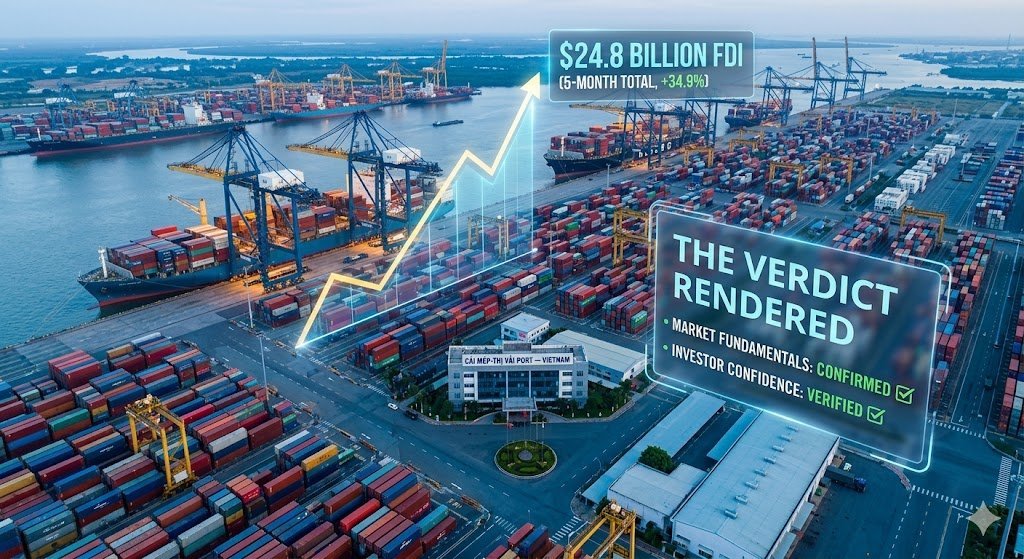
In the first five months of this year, Vietnam attracted $24.8 billion in foreign direct investment — a 34.9 percent increase on the same period last year, and the highest disbursement rate the country has seen in five years. Manufacturing accounts for more than 70 percent of that total. The number is striking on its own. But more interesting than the figure itself is what it represents: a verdict.
Fourteen months ago, when the United States proposed sweeping tariffs that would have placed a 46 percent rate on Vietnamese exports to America, the question on every executive’s mind was the same: how quickly can we adapt? Business plans built around export-led growth suddenly looked exposed. The urgency was understandable — and in many cases, appropriate. But disruption has a way of separating two kinds of businesses: those who understood what they were building before it arrived, and those who only understood it in the aftermath.
Vietnam’s government moved with speed and purpose. A framework trade agreement concluded with the United States in mid-2025 brought tariff rates down to 20 percent for most Vietnamese goods. What the Ministry of Planning and Investment’s FDI data is now confirming is that investors watched how this country navigated that moment — and drew their own conclusions. Vietnam’s fundamentals were never in question. A young, skilled, and increasingly technical workforce. Nearly 20 free trade agreements in force, with more under active negotiation. A government with a demonstrated ability to act at pace under pressure. The Vietnam Chamber of Commerce and Industry has argued consistently that Vietnam’s competitive position is built on more than cost — on quality, reliability, and a track record of delivery. The past five months of inbound capital are the proof.
At THP, we have spent more than thirty years operating on one foundational belief: that what is built right is built to last. When we launched the Number 1 energy drink in the mid-1990s, Vietnam was not yet on most multinationals’ radar. We did not have the advantage of global consensus validating the market. What we had was a product that was genuinely good, a team committed to the long term, and a family prepared to hold conviction through the years when the evidence was still coming in. What we have learned — sometimes the hard way — is that a company does not reveal its character in its best years. It reveals it in the years when staying steady is actually difficult. A company matures not by avoiding adversity, but by walking through it with discipline and values intact.
The FDI numbers are confirmation of something Vietnam has always understood: the investors who look past short-term disruption to ask what is actually true about a market tend to find it. I am optimistic about the next five years for Vietnam’s private sector — not because the road ahead will be smooth, but because the difficult passage of the last fourteen months has clarified what this country is, and what it is building. I strongly believe that clarity is its own kind of competitive advantage.