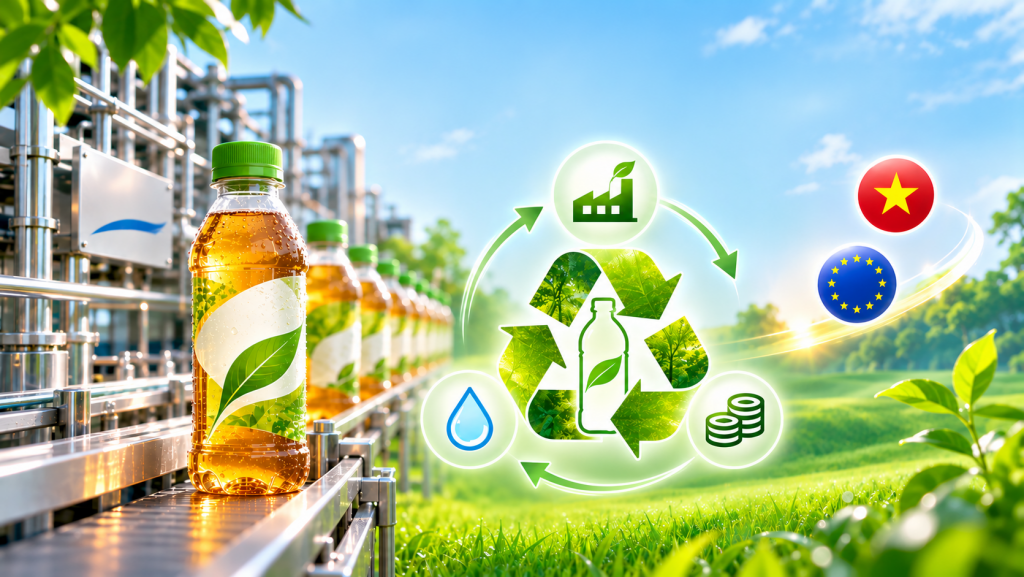
Since 25 May 2026, Vietnam’s Decree 110 has required producers and importers to recycle a share of the packaging they place on the market. Aluminium and rigid PET packaging carry a 22% recycling obligation, while paper, carton, and ferrous metal packaging carry 20%. Beverage makers rely heavily on exactly these materials. For manufacturers, packaging has stopped being only a design and procurement choice and has become a financial one.
Vietnam is not alone, and exporters will feel the pull from abroad. The European Union’s packaging regulation has applied directly since 12 August 2026, with deposit-return schemes for PET bottles and aluminium cans due by 2029 in countries that have not reached 90% collection, and recycled-content requirements for PET beverage bottles from 2030. Any Vietnamese producer selling into Europe is designing for those rules, whether or not it says so.
At home, producers can meet the obligation in three ways: recycle themselves, engage a third party, or contribute to the Vietnam Environment Protection Fund. That turns packaging into a make-or-pay decision. Companies with scale and control of their supply chains are better placed to build recovery into their operations, while others may find that paying the fund is the only practical route, and that cost will show up in margins. The decree also sets recycling percentages for an initial three-year period, which gives boards a planning window, not a permanent answer.
At Tan Hiep Phat, efficiency has been a long-running effort rather than a response to a decree. About ten years ago, we began a project to make our bottles nearly 20% lighter. Our equipment supplier, GEA, reports that our aseptic technology has helped cut water use by 91% and bottling energy by 31%, and that under a strategic partnership signed in October 2024 we committed to lower the use of virgin plastic, to increase use of recycled PET, and continue lowering natural resource usage overall. Efficiency of this kind compounds, because every gram of packaging avoided is a gram nobody has to recycle.
There are questions which Vietnamese beverage makers will now need to consider a great deal. What materials should be placed on the market, and how do they map against the 22% and 20% obligations? For each, is self-recycling, a third-party arrangement, or the fund the right choice, and at what cost? And does our packaging design meet the rules of the export markets we want to enter? Companies that treat packaging as an engineering and balance-sheet decision now will be ahead of those that can only treat it as paperwork response to a new decree.
“What we put on the market is ours to take care of long after it leaves the shelf.”
— Phương Uyên Trần