Phuong Uyen Tran
When the US-Vietnam trade framework reduced tariffs on Vietnamese goods from 46 percent to 20 percent last year, most analysts focused on export volumes, supply chain rerouting, and which industries stood to gain the most. What drew far less attention was a quieter shift happening inside Vietnam’s companies — in the composition of who was leading them.
According to Grant Thornton’s Women in Business 2026 report, women hold 32.9 percent of senior management roles globally — a figure that has barely moved in a decade. In most markets, progress has come through internal culture programs: well-intentioned and slow. But as tariff volatility, rerouted supply chains, and input cost inflation have become the permanent operating environment, a different quality of leadership, especially female leadership, is emerging as strategically important: patient, relational, and oriented toward durability rather than short-term performance.
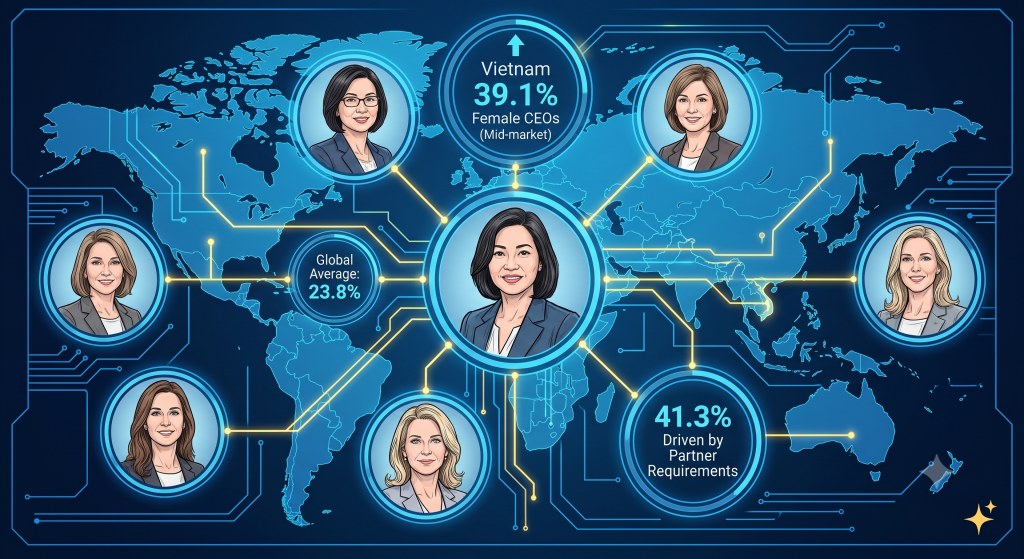
Vietnam’s numbers are striking. Women now hold 39.1 percent of CEO positions in Vietnamese mid-market firms — more than double the global average of 23.8 percent, and a figure that tripled in a single year. What is particularly notable is the driver: 41.3 percent of Vietnamese firms reviewed their diversity practices not because internal governance demanded it, but because supply chain partners required it. External accountability moved the needle faster than internal aspiration. Not a single surveyed company in Vietnam reported an all-male leadership team. For a country navigating one of its most complex trade environments in decades, that timing is not coincidental.
At THP, we have always operated on the belief that enduring companies are not built for the best of times — they are built for all of them, including tough times. The decision to invest in new manufacturing capacity did not come because conditions were easy. It came because we had decided, long before tariff announcements and logistics disruptions arrived, what kind of company we intended to be. That kind of decision-making — patient, values-anchored, thinking in decades rather than quarters — is what you find in businesses built to last. Family businesses have demonstrated this across generations: not by outmaneuvering every disruption, but by holding their course through it. When leadership is accountable to relationships — with partners, suppliers, communities, and the generation that comes next — companies do not just absorb volatility. They use it to separate themselves from those who were only built for calm.
The trade framework reduced tariffs. It did not reduce uncertainty. Geopolitical disruption is the permanent operating condition now, not an exception to plan around. The businesses that will compound their advantage through this decade are those led by people who think beyond the next tariff announcement — diverse, patient, grounded in long-term view. Vietnam’s numbers are worth more than a moment of celebration. I believe they are telling us something about the kind of economy we are quietly becoming.