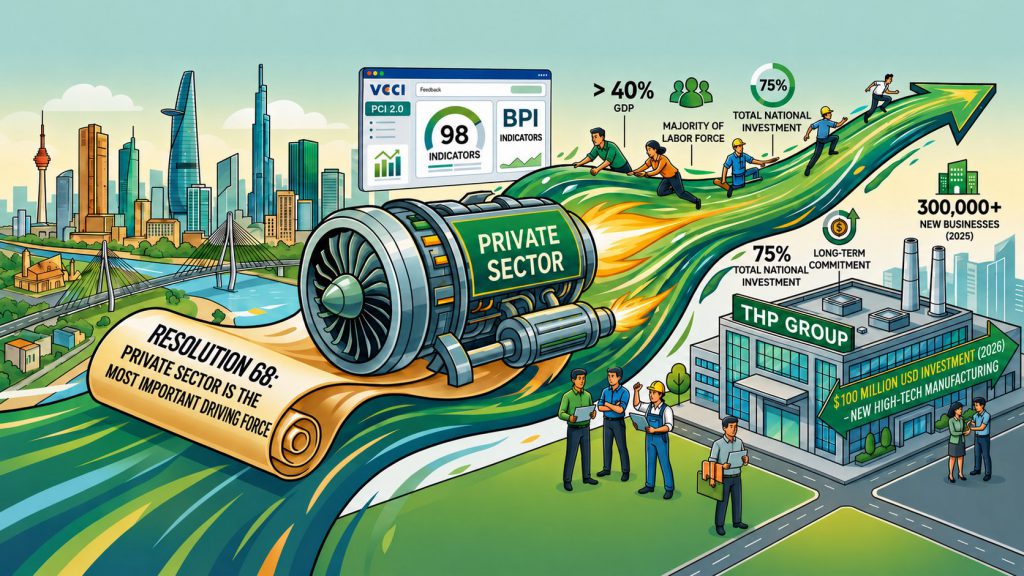
When a government formally declares that private enterprise is “the most important driving force” of its economy, it is worth pausing to understand what that really means. Resolution 68, passed earlier this year, did exactly that — marking a historic shift in how Vietnam’s leadership views the relationship between the state and the businesses that operate within it.
Private sector and long-term values
This is not simply a policy statement. Globally, we have seen a long arc bending toward the recognition that private enterprise — particularly businesses built on long-term conviction rather than quarterly targets — generates more durable economic value than state-directed alternatives. Countries that have learned to harness that energy, from Germany’s Mittelstand to Asia’s great family-owned conglomerates, have built industrial bases that outlast individual administrations. Vietnam is now signalling that it wants to write a similar story.
The numbers suggest the foundation is already there. Private firms contribute more than 40% of Vietnam’s GDP and employ the majority of the workforce. In 2025 alone, over 300,000 businesses were newly established or reactivated, with private capital accounting for nearly 75% of total national investment. The Vietnam Chamber of Commerce and Industry has responded in kind, overhauling its Provincial Competitiveness Index for the first time in 21 years — introducing PCI 2.0 with 98 indicators and a new Business Performance Index to measure private sector health with far greater precision. These are not the metrics of a sector playing a supporting role. They are the metrics of an economy’s engine.
Transformation with the new Private Economy Report
But declarations and indices only take us so far. What transforms policy into progress is the willingness of businesses to invest — in capital, in governance standards, and in the business environment itself. This is why Tan Hiep Phat has decided to become a strategic founding partner of the Private Economy Report with the VCCI. At its core, it is corporate responsibility: a commitment to building “a transparent, efficient, and modern business climate” that lifts every enterprise operating in Vietnam. It is a commitment THP backs with action, with a planned US$100 million investment in new factories and advanced manufacturing technology in 2026.
Resolution 68 is an invitation, not a guarantee. The private sector’s response will matter far more than the government’s declaration. The most resilient economies are not those where business waits for conditions to improve — they are ones where business helps build them. For me, that is the defining challenge, and the defining opportunity, for Vietnam’s entrepreneurs right now.
“The most resilient economies are not those where business waits for conditions to improve — they are ones where business helps build them.”
– Phuong Uyen Tran